Project Overview...
This project was completed with Seer Data and Analytics, and the Tomorrow Today Foundation
Role: Lead UX/ CX throughout the project. I was present for all workshops except the final one, due to being very late in my pregnancy. For the final workshop, Kristy Mansfield CEO, of Seer, took the lead.
Participants: Benalla's youth of 12 - 16 year olds. Workshops where hosted by the Tomorrow Today Foundation, participation was voluntary and run in two different age groups catering for different learning needs.
Dates: May 2018 - Jan 2019. 6 workshop days delivered as 2 days over 3 separate weeks.
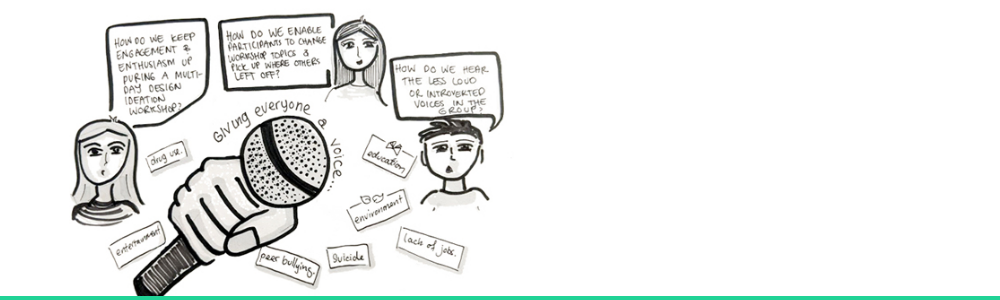
Topics covered during exploration: suicide, peer bullying, lack of jobs, their education, the environment, entertainment, and drug use within the community.
Skills used:
Product Ideation and pivoting
Directional Research/ Feedback loops/ Analytics/
Designing for Accessibility
Instructional design
Workshop facilitation
Omnichannel Design
Strategy through social channels
Onboarding and change management
Design Thinking tools used: - Mindmapping - Qualitative and Quantitative interviews - Contextual enquiries - Competitive analysis - Journey Mapping - Personas - Generation of ideas - Feature prioritisation - Value prop statements. Also up-skilled the kids in: - The digital workflow - Creating MVPs - Design 101 - Marketing 101
Role involved: Principle materials creator, workshop facilitator, and on the day host, analysed the created content between the workshops, reporting back to Tomorrow Today and Seer Founders
Short brief: Design and host 6 workshops for 2 different age groups, spanning 6 over month time period on Benalla community topics that could be anything on the day.
There were plenty of challenges I would need to overcome to give these workshops a possibility of success. My initial thoughts are listed below.
- I don't want this to be just a Design Thinking workshop.
- How the heck do we make 'Design Ideation and creation' interesting for them?!
- This will be a completely a different way of working for the school kids.
- These are school kids that are volunteering their time, we don't have a captive audience.
- How do we hear the quieter voices in the group?
- Not everybody likes the spotlight on them and everybody watching their every move.
- How do we get the introverts to participate as much as the extraverts and their contributions to have clarity?
- How would I deal with the possibility that the participant will want to change topics one workshop to the next?
- When the groups come together for workshop round 2 and 3, would the chosen societal issue be the same one that they want to work on? How would the kids pick up where they left off? We don't want to spend much time in re-cap mode, as we wanted to cover an expansive area within the topics.
- What happens if a group member wants to change topic areas between workshops that are held 3 months apart? Or if they skip a session altogether? Could they comfortably rejoin again?
- What happens when a subject area gets closed due to lack of votes going forward? How can those kids working on that topic go forward and rejoin the workshop?
- How would I create a single workshop plan that enables different ideas to be developed organically?
- What societal issue would take their interest, and would our workshop schedule be dynamic enough to allow for all these potential topic areas to be completed within our workshop structure?
Each workshop would need a dynamic plan of attack. This was how I approached these problems areas for the Benalla Workshops.
1. How I made sure that this was not just a generic Design Thinking workshop
I had to look at modifying the usual Design Thinking toolkit for 12 - 16 year olds, in a way that they would grasp the ideas, and embrace them. I needed to think about all the tools and processes I used when in Ideation mode, and of those, what could be easily transferable and quickly taught to kids in a way that they could understand. We wanted it to be obvious to the kids they would be able to complete the Design thinking ideation exercises, such as journey maps and persona charts etc. And ensure they could learn to take them beyond the workshop, but prompting them to ask:
- Why they might be using this tool to help solve the problem at hand?
- When they might use this tool in the their future careers, for context and purpose.
- When applicable, we had members from the Seer team explain a real life example of when the have used the tool in their work.
- Using visual aids when necessary, and being able to link it to an everyday item eg: understanding a Minimum Viable Product (MVP) through cars, and optional extras.
- If possible, relate it back to school work that they may be participating in at the time. eg: Commerce, and learning about the 4 P's of Product, Place, Promotion, and Price.
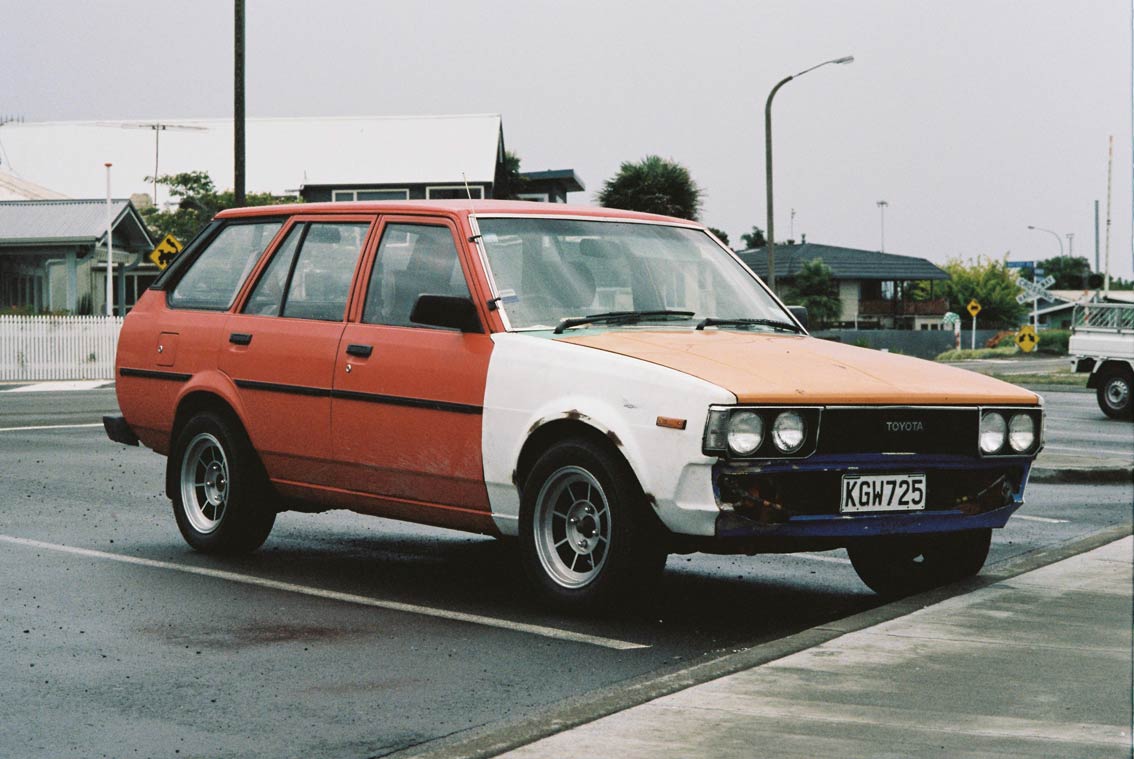
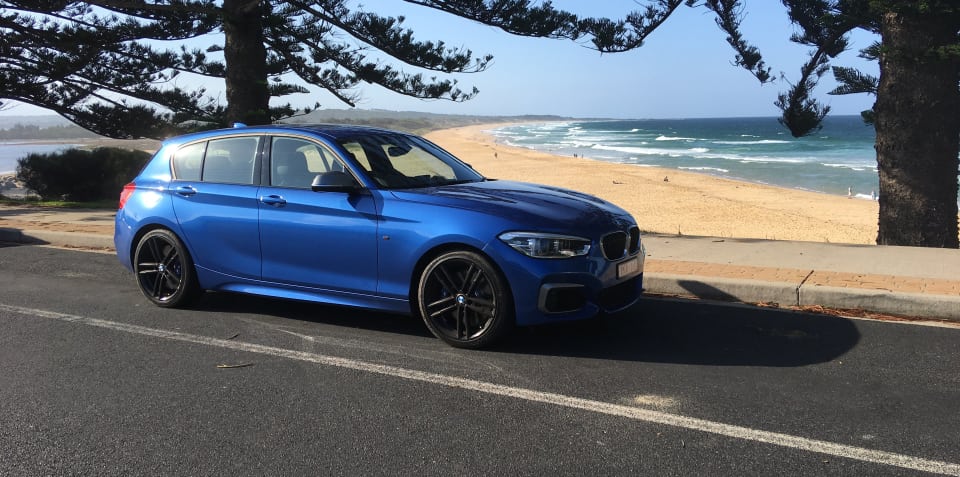

Understanding the different stages of the MVP, through cars and their features.
Corolla: (Orange/White)
- Patched together, might not look pretty but it gets you from A to B.
- Things might not work as well as they should but you can get there with a bit of effort and patience.
BMW: (Blue)
- Nice, working machine. Things have been optimised for your use and enjoyment.
- Most wants are catered for and delivered in a way to meet or slightly exceed expectations.
Lamborghini: (Red)
- Optimised for your maximised driving pleasure.
- Every need is catered for, expertly crafted for maximised enjoyment.
- you will look cool, know it will perform perfectly, and most likely will exceed expectations on every level.
2. How did we make sure that we heard the quieter voices in the group?
Design thinking workshops are fun, but personally, being an introvert it can feel daunting participating, even just through the written word, let alone speaking out.
Throughout the sessions I made sure that there were various ways of collecting ideas. There were the traditional group worksheets, mind-mapping exercises on butchers paper, and post-stick walls of contributions. But we also used visual exploration, by completing experiential sketching exercises to think about the different mediums (touch points) our solutions could cover, brain-dumping impromptu ideas, anonymously, into the central bucket for later discussion, and running an explorative field study - to see the environment issue first hand in the community: We went to see how much litter was about, where it was gathering, what type it was, whether the local take-away shops were to blame, or the locations of the bins and/or the frequency of their removals.
It was important to me that everyone could find their voice and feel comfortable participating, so we would get the most engagement out of these workshops, and ultimately I thought we ended up with a better result because of it.

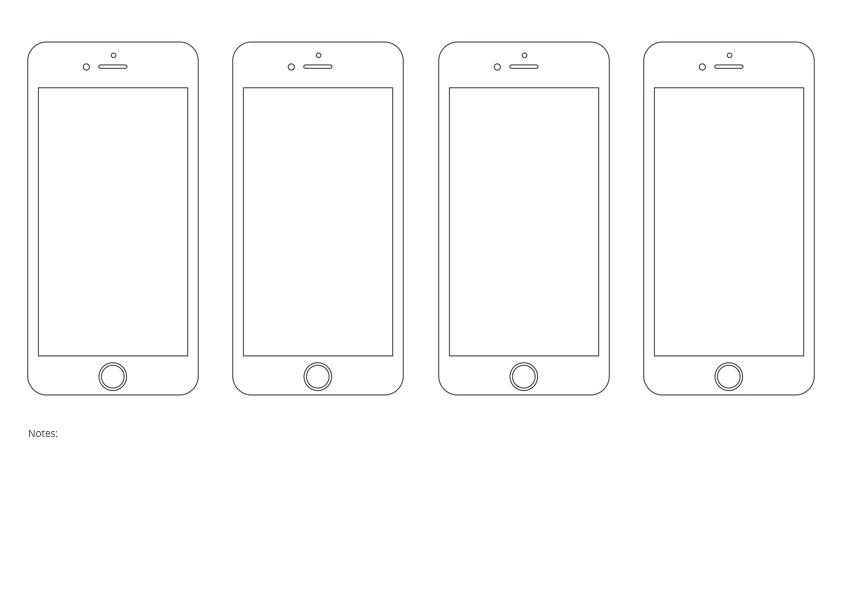


Participants were asked to imagine a solution that is to be accessed on through an online site. For round 2, participants were asked to imagine a solution that is to be accessed on a social sites. For the last round, participants were asked to storyboard an offline solution that could be within the community. The Storyboard squares were used on multiple occasions for the development of rapid-draw possible solutions and also exploring scenarios within their topic area. Attached shows one of the student's anxiety about achieving the ATAR that her parents seek.
3. Our solution for the changing of young minds and to keep progress happening:
Keeping the engagement up between workshops would always be a challenge... and I didn't want the kids to feel locked in to an issue if they explored it in one session and it is no longer of piqued interest. I had to find a way that we could jump to the next workshop without feeling like there's a huge gap between and for them to forget about all the amazing work that was completed.
Working closely with Tomorrow Today, I made sure between the workshops all previous group work was analysed and summarised. Further questions were then brainstormed and then asked back to the Benalla community (all ages) via Tomorrow Today. I also prepared reference material, collected from organisations relevant to the topic areas covered within the workshop, and the why, what, when, how's, etc. This was all packaged up ready for the next group to start in the following workshop.
Some of the questions asked back to the Benalla community, after their was work completed on the subject of Bullying.
- Why don't bystanders come and help those getting bullied?
- What programs have been ran in Benalla Schools to help stop/ Curve bullying?
- Do Friends know when a fellow friend is getting bullied?
- Do Social Sites do anything about bully videos being published?
- Do parents know, or see a behaviour change when their son/daughter is getting bullied?
- Why do kids often fear that any action by an outside source will worsen the problem?
- What are some behaviour changes in someone that is getting bullied?
- Is there a certain demographic that we have found are likely to turn to be out to be a bully?
To kick-start our workshops we supplied a folder with reference material regarding each topic. This was an example of the Bullying folder contents ready for workshop 2.
- All design Thinking exercise results, completed by the previous groups, on the topic of bullying.
- All community questionnaire feedback gathered from Tomorrow Today regarding questions raised about bullying, prompted from the workshops. (examples above).
- Website printouts referencing the questions raised during and after the Design thinking workshops regarding bullying. eg: Why are bullied children reluctant to seek help from teachers?
- Material covering topics covered in local anti-bullying workshops and programs.
- Online resource material aimed to help students, parents and teachers.
- Distributed materials about bullying from other schools.
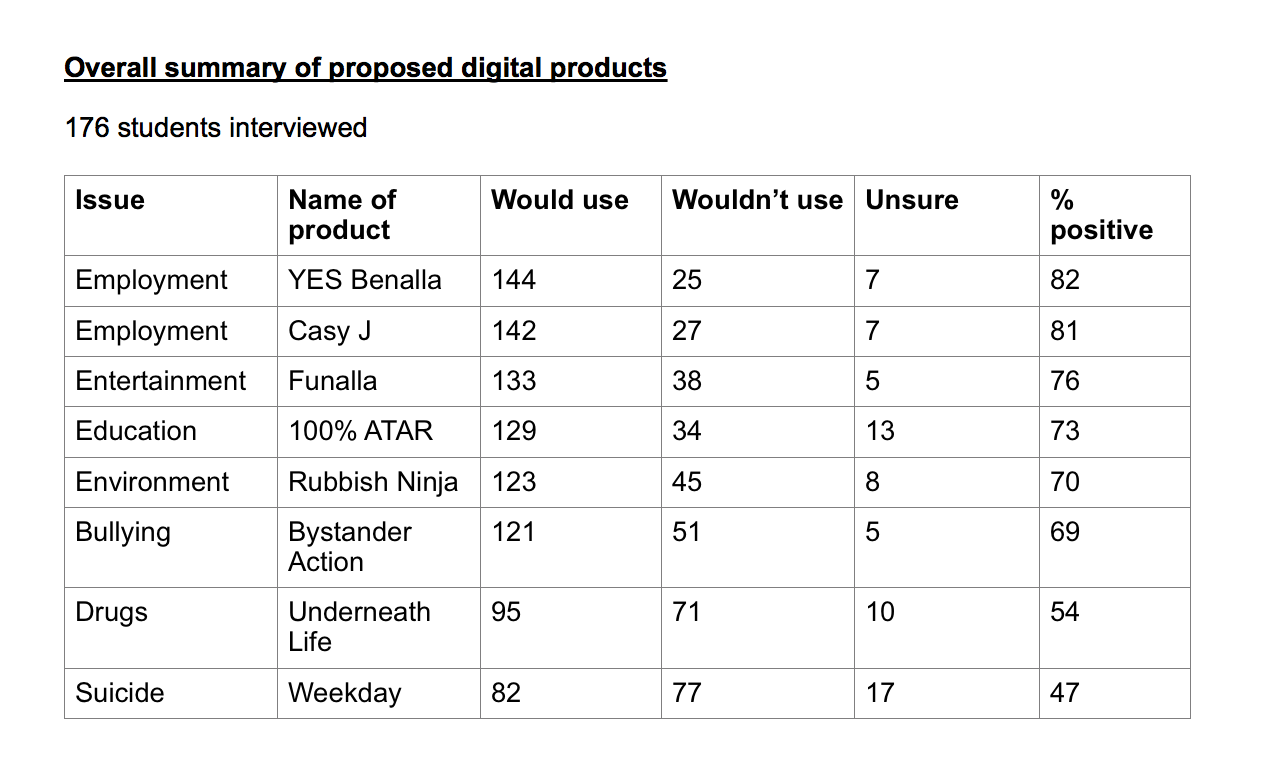
During the workshops there was also a huge effort to keep the engagement high and people discussing the societal issues of Benalla. Working closely with Tomorrow Today, a huge amount of quantitative interviews were conducted with students, parents and the wider community about the topics raised by kids at the workshops. There was a roaming community wall to show stats and the findings of Tomorrow Todays research. People were able to vote upon ideas and also had a presence on Social Media for voting and discussions. We wanted to engage with the community and understand what was really happening with Benalla. Also this kept the School Holiday workshops in peoples minds.
4. Our solution for running a single workshop covering many issues:
This was always going to be a challenge but the main thing was to let the content be open ended enough to hold Design Thinking exercises, and then be able to bring it back to the wider group during several intervals during the day.
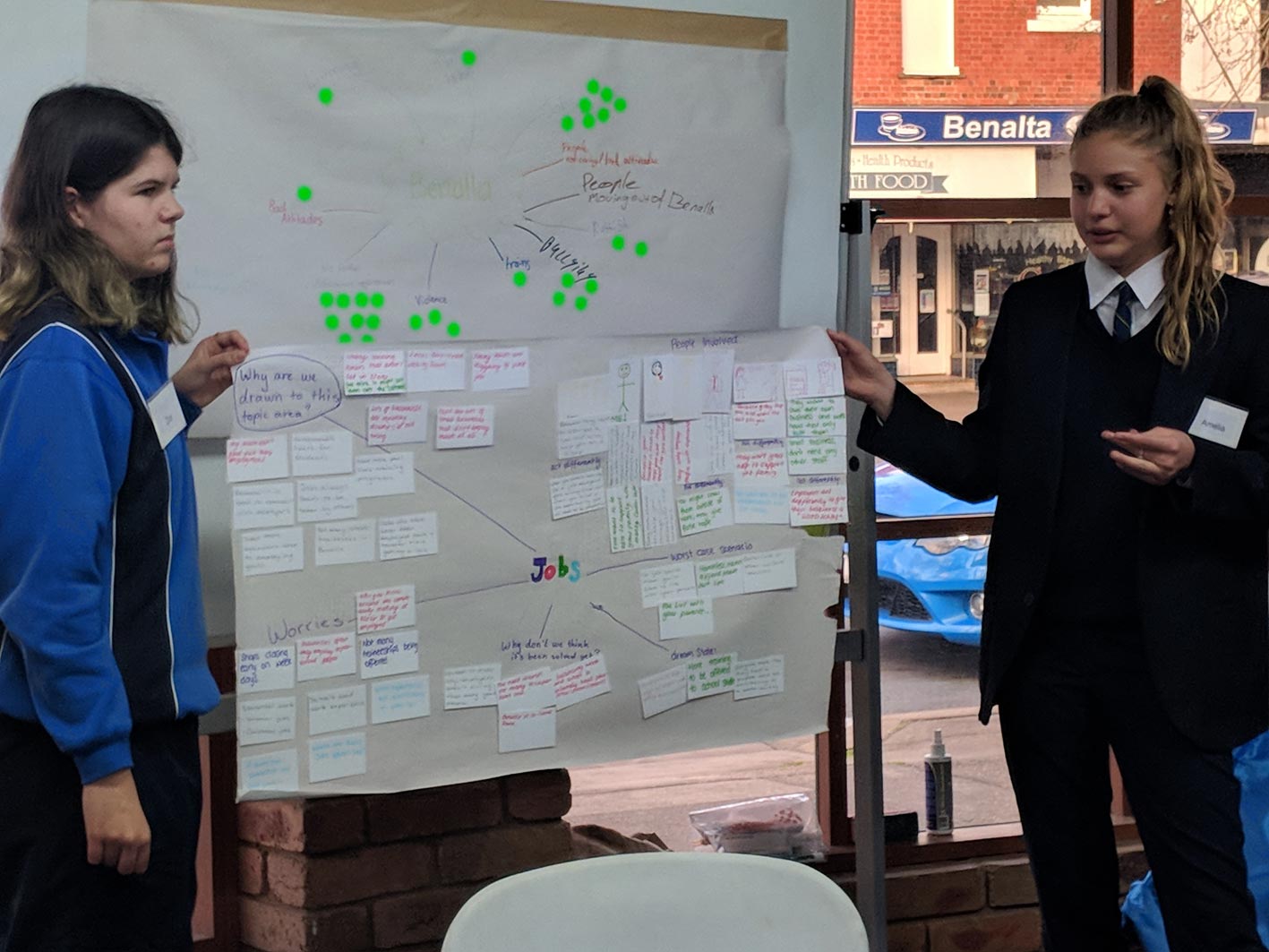
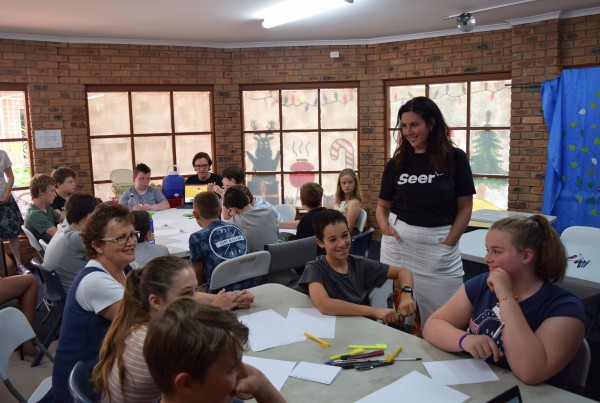
We had 3 members from Seer, and several from the Tomorrow Today Foundation, which enabled us to break into smaller exploration groups. The community issues all followed the same master plan and design thinking exercises conducted within small groups, but the workshop questions were posed slightly differently, and different resource materials supplied to aid research into the topic areas.
Before the Benalla Kids began brainstorming the topics they wanted to explore in the first workshop, we had been in discussion with Tomorrow Today to predict the community topics that might arise, and problems associated with some of the topics. Heavy topics, such as suicide and bullying, were very close to the kids within the community, and a counsellor had to be made available at all times. Predicting student outcomes proved handy for us, because we could make sure the topics that were likely to be selected could fit within our framework.
Workshop 2, carried on with the topics explored in workshop 1. Workshop 3's topic was selected after an extensive voting process involving the community, and was selected 2 months before the final workshop started.
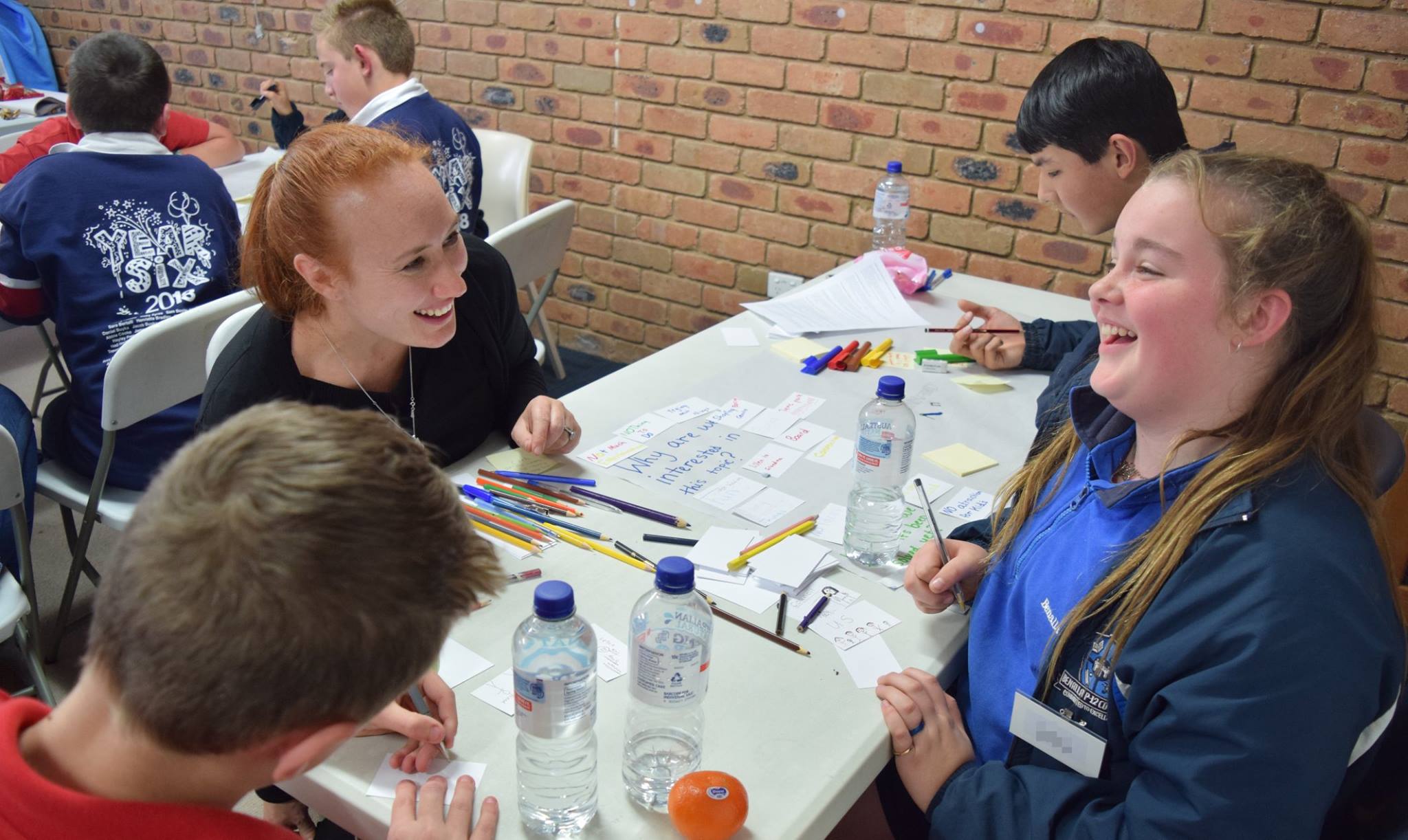
The most variable section of the entire workshop was when we were deep-diving into what a 'competitive analysis' is. I had an Idea about supplying resource material and the groups would discus the pro's and cons for each item and gather the best components for their future products. We had one group analysing CVs and cover letters, another looking at Bullying programs and discussing what they would think would work and then another group doing a short field trip in the community looking at where the bins were placed and the analysis of trash nearby.
It all worked in the end, with each group coming up with amazing, innovative ideas to help the Benalla community tackle some of their biggest problems. It was a lot of work at our end, but keeping it open helped with engagement, and discussions being had and helping the kids understand that the tools that they are learning can be applied to so many different topics and scenarios now and in the future.