Project Overview...
This project was completed for Airtasker, Australia
Role: This was completed as a strategy deck for Airtasker as part of a selection process. Ultimately the client was looking for a greater focus on UI/UX rather than strategic CX/UX.
Dates: March 2018
Skills used:
Business Strategy
Ideation of creative
Directional Research
Inclusiveness for all
Digital Creative
Onboarding helpers
Design Thinking tools used: - Mindmapping - Digital platform analysis - Journey Mapping - Personas - Generation of ideas
Short brief: Reinvigorate the 'My Tasks' page on the App by using UX methodologies.
I didn't have the access or time to conduct interviews with Airtasker users, nor access to the app's stats/ analytics/ heat maps, to truly understand where problematic issues were. How to take a product forward if we can only assume where the problems lie? This was how I tackled this common spec work scenario, to build a comprehensive understanding of where Airtasker currently sits in the eyes of the consumer: from its current social media pages and web reviews.
Common UX/CX toolkit to take a product forward...
- Have the ability to conduct interviews for directional research To gain an understanding about the pain points of a product and understand what needs updating and possible insight on how to tackle problem areas.
- Have access to some Data and Analytics of your sites performance The Stats never lie! You can gain an understanding on visitor rates, drop offs/bounces, conversion rates, time spent on page, incoming URL sources, Marketing effectiveness etc.
- Have the ability to conduct A/B Tests If you are unsure of the performance, being able to conduct experiments to see whether updates perform better or worse and their effectiveness at conversions for sales or getting in touch.
- Have access to Heat-mapping tools Code that enables you to see how users spend time on your site and understand what they are attracted to, the number of clicks or attempted clicks on buttons etc.
For this brief I only could utilise...
- Personal experience with the product Asking myself how has my experience been? What would I fix, update and change to make this product/service better?
- Social Pages of the product Analysing what type of content they post, replies and the sentiment of the content.
- Web presence of the product Analysing content made available from Searching on Google. This could be advertising, write-ups, newsletters, advertorials, blogs, vlogs, interviews, opinion pieces. What point are they trying to convey and does it match how they are received?
- Other public collateral Access downloadable content, specialised talks or Meetups, offline advertising content.
Where do you start on an open-ended brief? How I reinvigorated and redesigned the digital offering by using a non-standard Design Thinking Toolkit.
It definitely helped me to pinpoint who my intended audience was: a new user and thinking about what "jobs to be done"they had. Jobs to be done is simply a phrase to describe what your user is trying to achieve (goals), as they interact with your product or service.
At this point, we don't know much about our persona "Suzie", except that she is new to Airtasker and their offerings, and wants to start posting jobs within the "My Tasks" space. Pretty nondescript.
I also penned a pretty generic secondary business goal during this redesign: to improve consumer confidence whilst completing these steps, as well as ensuring success so the user would become a long term brand ambassador.
Why am I running with both a 'Jobs to Done' goal, and a business objective within one brief?
Businesses need motivation to transition or change what is already working. I have found that most UX/CX professionals know about the benefits of designing for a persona, tackling their pain-points and frustrations, and helping them successfully complete tasks. But the task of convincing the business stakeholders to get on board, and answering their "why should be do this is" is where the struggle usually lies when rejuvenating existing offerings.
The Business goals...
- Improving consumer confidence When a consumer is confident in their decisions they are likely to convert to a sale, refer a friend, speak positively towards the brand, repeat purchase, spend more etc. and most companies seek this amongst their users.
- Becoming a long term brand ambassador This is all about retention, and the likelihood they will continue to use your product, refer your product, or speak positively about your product to others. Always great to have free airtime.
Companies need to be motivated to make changes to their existing offerings. It takes time and money to change, so I find out what motivates the stakeholders, and talk their language. I use before and after metrics when possible, and regularly present updates and clear summaries.
Taking it step by step:
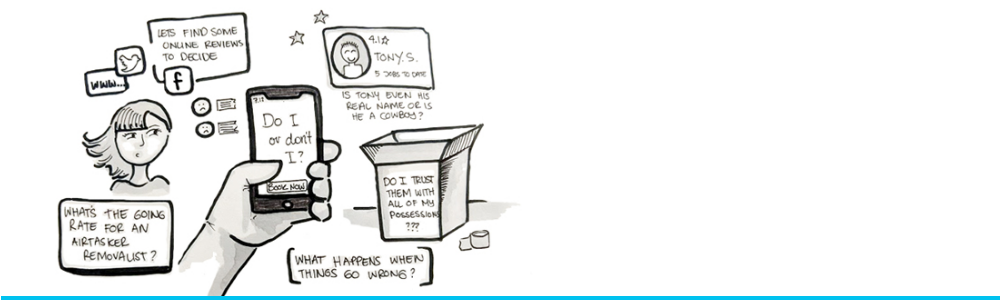
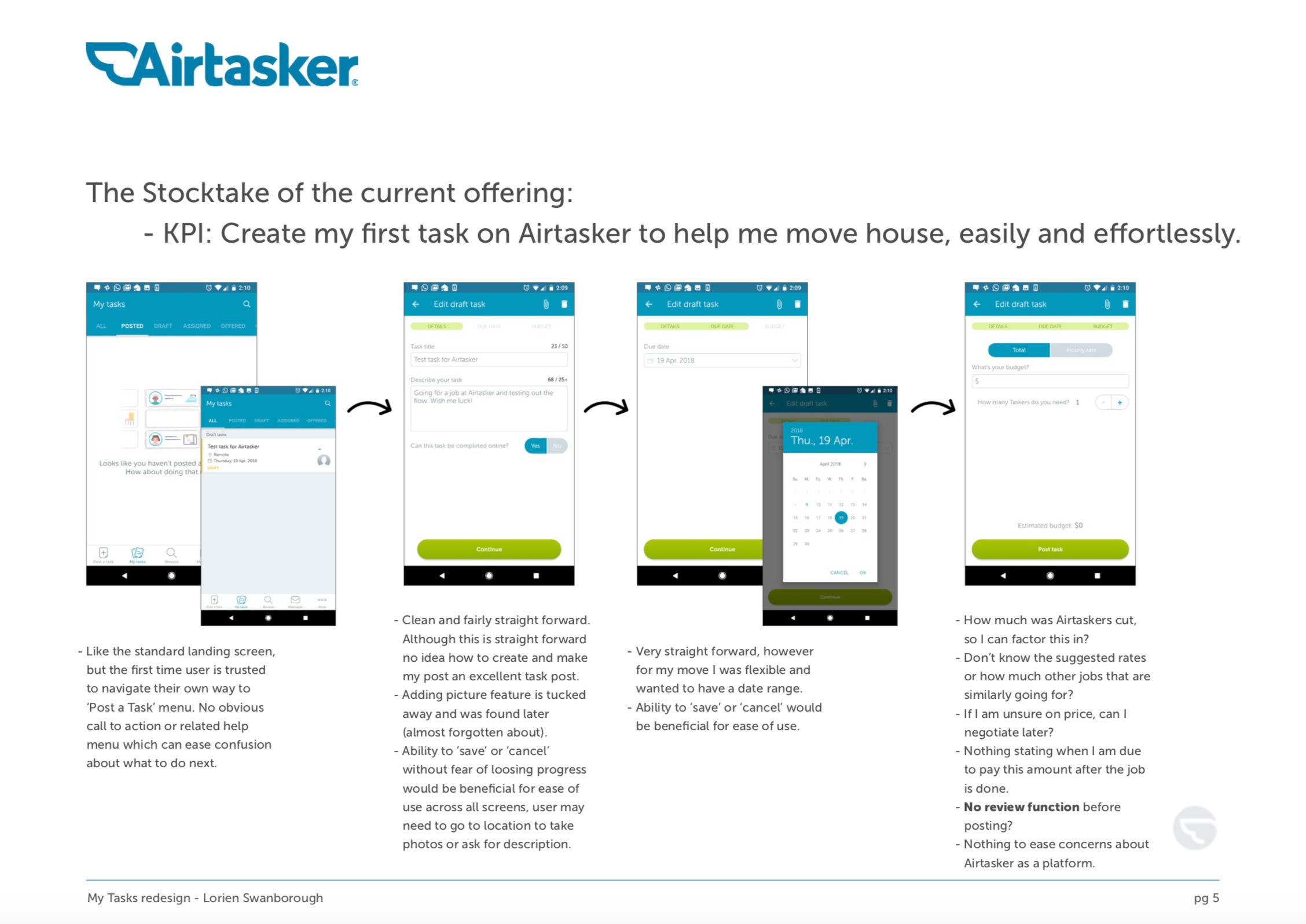
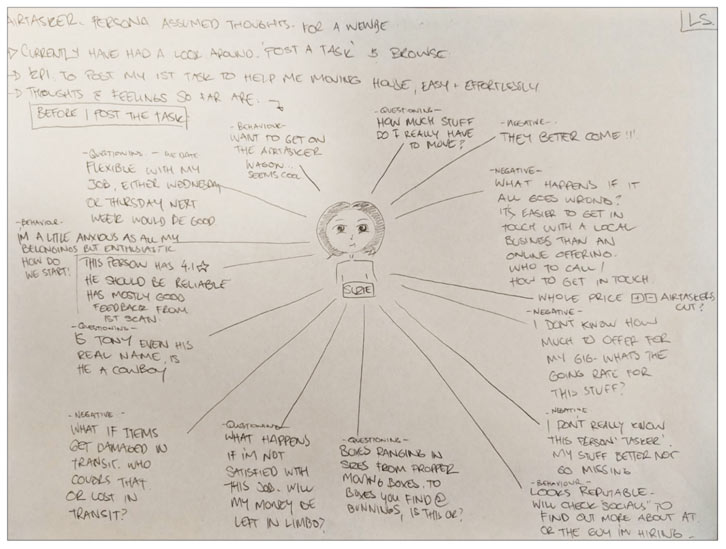
Step 1: Understanding the current offering by doing a UX/CX stocktake. I am in the similar circumstance to Suzie... I was a new potential user to Airtasker and upon signing up, this would be my first chance to look at the "My Tasks" page. Outside of work I was moving house, and so my "Jobs to be done" was to create my first task on Airtasker to help me move house, easily and effortlessly, around mid March. As I was going through the app and doing a stocktake, I listed what worked well, what I was second guessing, questions that I had, and what I thought was missing in terms of functionality. Although I was listing my personal thoughts, you can be almost guaranteed that I am not the only one experiencing it, and Suzie who would be new to the platform could be experiencing the same thoughts.
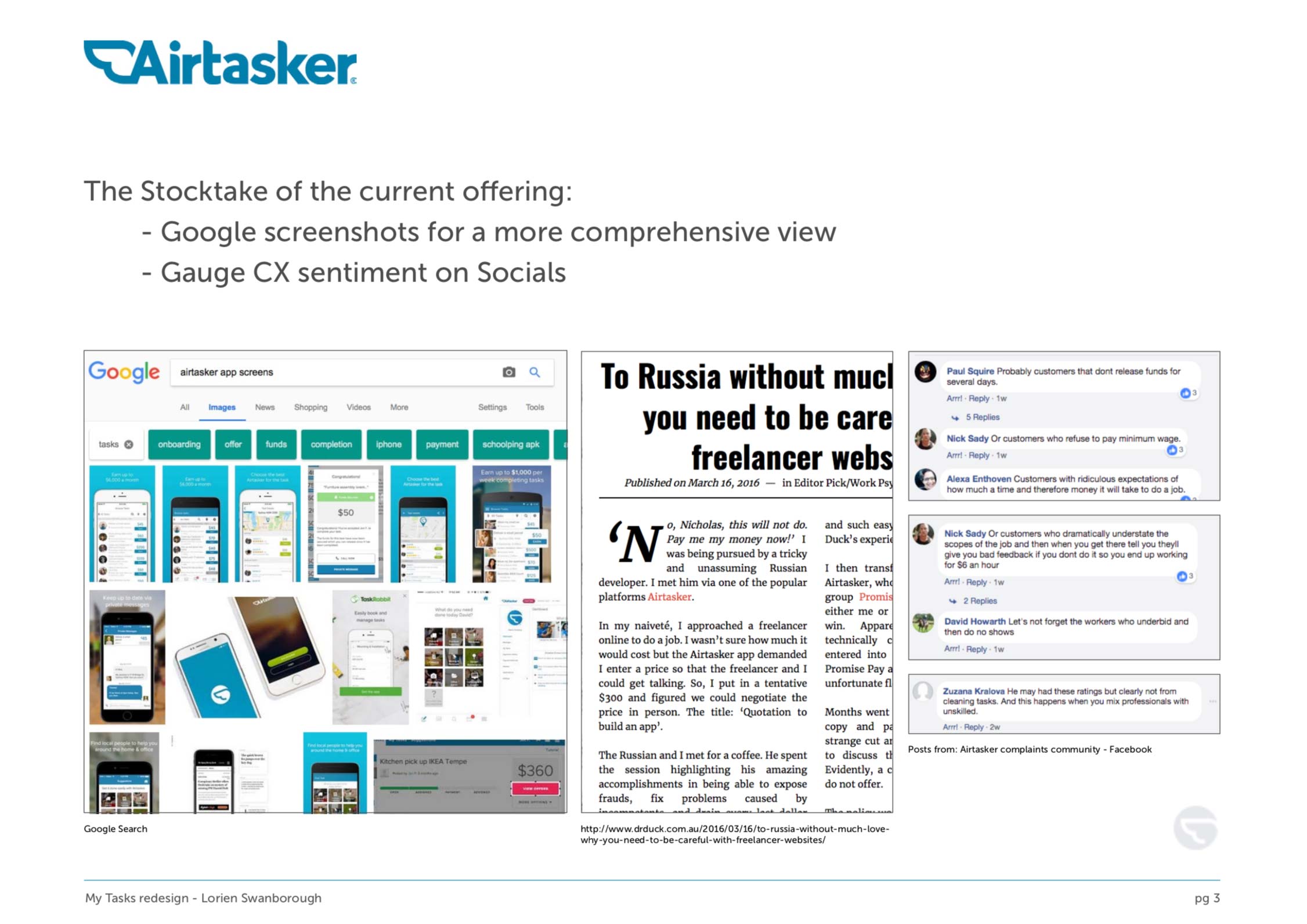
Step 2: Gaining other people's point of view through an alternate interview process. Usually a UX/CX Designer would turn to conducting qualitative interviews. However, for companies that are well known in the public eye, and around for a while, a Google search can reveal a wealth of information ready for interpreting. It's unfiltered, honest, and not always what you could be expecting to hear about a company. It may be from other user groups - in this case not someone using the platform for the first time - but still helpful to gather, collate and try to understand the differing perspectives.
Please remember that when you are researching opinions from the public there will always be two sides (cause and effect) to the information that you discover. It is also super important to try and find out "why" people are sharing the information they are, or the situation they are in when this feedback takes place. Repetition of themes could be a good way to see how common a problem is.
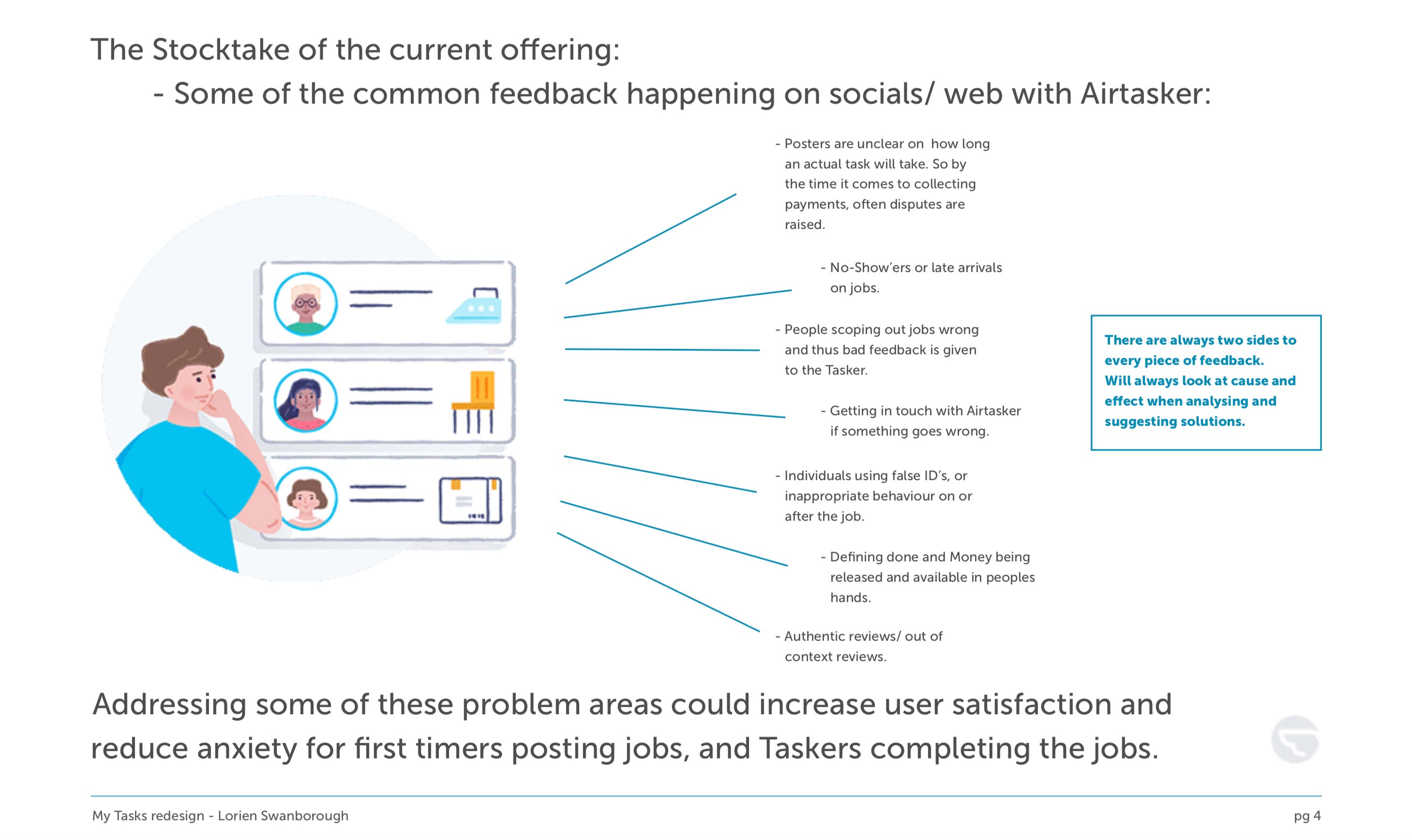
Step 3: Understand how well a company is received by looking into their socials to see what is revealed. I definitely went down some rabbit holes! Facebook and Twitter usually host a company site, but I also uncovered some unofficial sites that were full of rants and dislikes of Airtaskers. All information revealed can be of use. Take note of offical statements or advertorials from Airtasker posts, and understand their stance and point of view, or how they want to position themselves in the public eye. Also seek out counter-complaints from unhappy customers and their experiences. You want to take note of any recurring themes or common problems. I listed mine as: "Some of the common feedback happening on socials/ web with Airtasker" and analyse the sentiment of these statements.
Step 4: After you have exhausted your search, do a visual stocktake of your findings. I put this information into a "persona mindmap" around Suzie to express my concerns "pains" that I, and others (through the socials and web searches), felt or had encountered at this stage of posting a job ad, and trying to get a task completed by a Airtasker.
Step 5: Bringing it all together: I then went through screen by screen and acknowledged where each painpoint from "Suzie" lay in terms when the user interacts with the app or service. With each pain-point, I then gave a brief sketch and/or explanation about how I would tackle each pain-point, why these fixes might aid improving engagement, retention, increase posting etc.
This was hypothesising and ‘Blue Sky thinking’ all the way, and if changes were put in place I would expect this to be measured with A/B trials, before and after metrics applied, and looking at resulting socials to see whether customer sentiment about onboarding and the general use of the Airtasker service had improved.
Conclusion
Although we don't know 100% what stops us from booking an Airtasker over a traditional removalist, I definitely wasn't ready to start using the service for my move. But by completing this persona work, analysing sentiments, and hypothesising possible fixes to these researched pain-points we could be well on our way to improving my, and other peoples' confidence with posting their first task on the 'My Task' Page.
This was an alternate to the somewhat formal, creating a persona, creating journey maps normally created and used within a Design Thinking toolkit. When using information from social sources, we look for repetition of themes, issues, not just one-off statements that could be trolling or unsocial behaviour. User sentiment was analysed from my own judgement, however more formal analysis tools can be applied. Everything collected is taken with a pinch of salt!